
QZ qz thoughts
a blog from Eli the Bearded
Tag search results for photography Page 1 of 3

Taking Apart a Locking Shopping Cart Wheel


These are old photos from something I did about ten years ago, but I thought I'd share them for people interested.

Some supermarkets around here, in order to combat people walking off with their shopping carts, have wheels that lock when they roll over a line with some sort of short range signal coming out of it. I don't really know the specifics of how the signal is sent.

Broken off shopping cart wheel on work bench

This is how (but not where) I found this item. Snapped off, probably deliberately by someone who didn't like the locking wheel. "Gatekeeper" name and Pat. 5598144

I've been curious about the anti-theft shopping cart wheels for a while. It's clear that they are radio operated by a signal with a very short broadcast range. Less clear was how they actually stop the wheel from turning. My original hypothesis that the wheel contained a motor which would actively stop the wheel from moving. After finding a wheel that had broken off a cart (honest, I had been watching out for one for several years before finding one; this one was in a Target parking lot), I took it home and opened it up.

Starting to take it apart

Afer removing the axle bolt, just a philips head screwdriver needed.

Side of the wheel removed

You can't see much yet, but the basic operation is revealed.

It turns out my hypothesis was far off. The center part of the wheel is fixed in place, well anchored to the axle which does not spin. Put another way: the outer part of the wheel moves, but the axle and the inner part do not. When the system receives a signal, it expands a plastic drum brake against the outer rim of the wheel, to prevent the wheel from spinng. When it receives an unlock signal, the plastic drum brake is retracted. During normal operation the only power draw is a small circuit listening for those radio(?) signals. At those times, it then switches on a motor to expand or retract the brake.

Inner part removed

The ridges on the inner and outer part interact when the wheel is locked.

Inner part flipped over

Now you can see the levers that activate the drum brake, expanding or contracting the ridged inner plastic.

Battery cover and battery removed, on flipped over side

These CR123 lithium cells are a common long life / high power non-rechargable battery. Checking prices today, a twelve pack costs about $45 from Home Depot.

Flipped over again and cover of inner part removed

You can see the motor and gears, the driver board with an antenna near the rim, and the waterproofing orange gasket.

Shank and axle removed

Heavy sheet metal here to hold this inner part still.

All of the parts in a pile to discard and a tray to save

I saved some of the metal bits, but tossed all of the wheel and brake.

This post prompted by learing of begaydocrime.com which has more technical detail and audio files you can play to lock or unlock this sort of wheel.


Painting Ads

There's a painting company in San Francisco that tapes up terribly designed, but mostly memorable, flyers on poles all over the city. I've been trying to find all of the variations.

Adverting flyer for room painting

One of the original designs, a multiple font mess evoking a ransom note in consistency.

Adverting flyer for room painting

"DEER CROSSING Tis The Season To Save Some Bucks On Interior House Painting"

Adverting flyer for room painting

"Do This" (ie, Evel Knievel stunts) instead of painting yourself.

Adverting flyer for room painting

"One less Bell to answer,
One less Egg to fry,
One less Mess to pick
Up after?"
With a Valentine's Day picture.

Adverting flyer for room painting

"Are There Little Green Men In Your Head?"

Adverting flyer for room painting

"On Your Path To Interior Appearance Inner Peace"

Adverting flyer for room painting

"Having A Wedding? A Party? An Affaire?" Another with a Valentine's stock photo

Adverting flyer for room painting

"THE RACE IS ON" with roadster versus steam locomotive
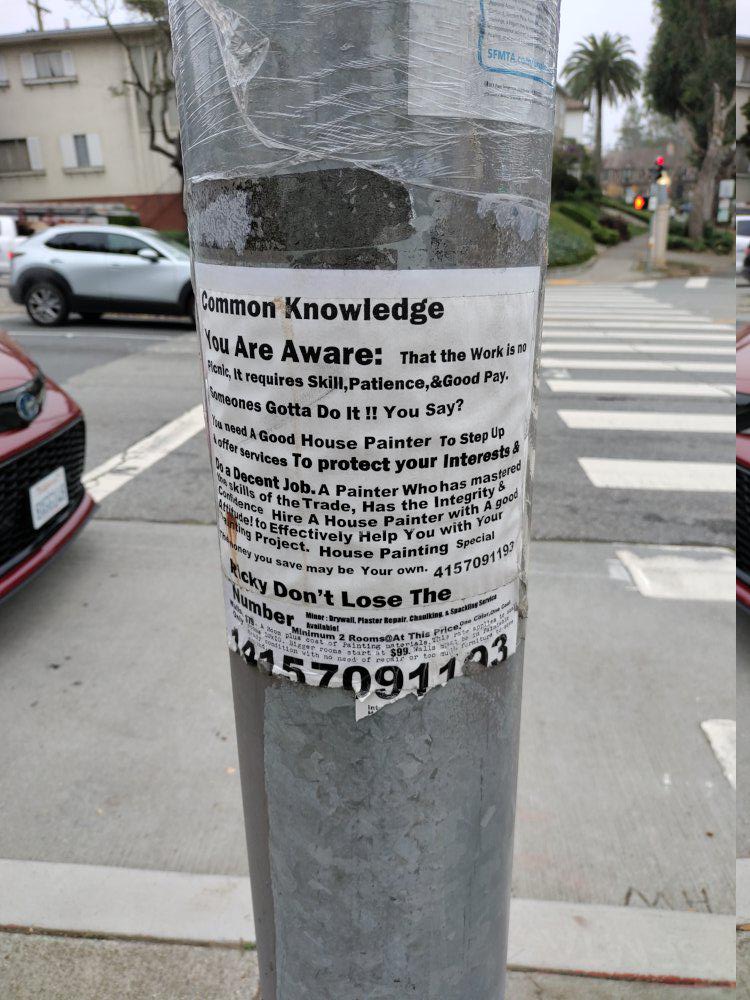
Adverting flyer for room painting

Wall of text ending with "Ricky Don't Lose The Number"

Adverting flyer for room painting

"IN SEARCH OF SANITY?"

The next few are much rarer versions.

Adverting flyer for room painting

"Looking?" Looking like a personal ad, the rare clean design.

Adverting flyer for room painting

Room painting as easy as ordering a burrito. Lengua con frijoles refritos, por favor.

Adverting flyer for room painting

Spock says of getting your painting done now: "Correct, it's the logical choice captain"

Adverting flyer for room painting

"Do Something nice For your Landlord!" Because it's welll known that renters like to help landlords out.

Magneto-Optical


In the 1990s, I had an Apple Mac IIci with A/UX. Most of that is a story for another day. All I have left from that system are a few 3.5" (90 mm) floppy disks, a couple of CD-ROM with programs that run on multiple systems (eg, Infocom Games), and my magneto-optical stuff.

I had done my homework researching storage systems for backups. The best sources I had said that Zip drives were "bad", CD-R was "good", and magneto-optical (MO) was "archival". Zips were the cheapest drives of those, and CD-R the most expensive. Media was another matter, I recall CD-R as being cheapest. Media capacity was another thing. My main hard dirve was just 80MB, so a 100MB Zip drive or 128MB MO disk was a huge amount of space, and a CD-R disk was nearly impossible to completely use.

More than two decades on, the longevity advice seems to have been sound. There's a gotcha, however. MO has basically disappeared as a format. Speciallized industrial use apparently exists. Even the audio version, the minidisc, never gained a lot of traction (at least in the US; Japan is another story). CD-R and CD-RW has proved to be a bit fragile, but it is also very widely available, and eventually the media got very cheap, so making multiple copies and duplicating stuff every year is reasonable.

When I was getting rid of my Mac IIci, I kept the MO drive and disks. Then I bought a computer with a SCSI card to be able to read the files. I've still got that computer (although it works poorly), the SCSI card, my MO drive, and all my MO disks. About five years ago I spun up the computer and drive and copied everything to CD-R. About two years ago, I copied those CD-Rs to back-up hard drives. One was bad. I should really spin the whole thing up again and make new copies from the MO disks, but for today, here's some photos.

MO drive, disks, PCI SCSI card

The whole shebang. MO drive, some disks, PCI SCSI card

The 128 megabyte size MO was the smallest version of MO. In the 90mm form, 128 and 230 were available at the time I was buying, and larger capacities in 5.25" (130mm). Eventually disks up to 2 gigabytes were available in 90mm. As an aside, I was quite fond of that Idemitsu logo.

MO disk closeup open

MO disk closeup open. Sector partitions are clearly visible. I used tape to hold it open for this shot, normally it springs shut.

MO end view, next to floppy

The MO disks are about twice as thick as a 3.5" floppy.

disk side by side with floppy front

Same size, and very similar to 3.5" floppy from front

Pencilled in there is a summary of the partition table. This habit of mine made finding the partitions to read the files off from Linux much easier.

disk side by side with floppy back

And from the back; note thought the cover extends over the hub

disk side by side with floppy, MO opened

Back opened to show MO hub

The MO disks are bigger (in thickness), sturdier, and fancier than 3.5" floppies. Since the disks are sectored, the system doesn't need a notch in the hub to align things.

MO drive top with nameplate

MO drive top with nameplate, Epson OMD-5000, December 1992. Pretty sure I got this late 1993 or early 1994.

This was originally in an external enclosure with a 25-pin Mac-style SCSI connector. I pulled the drive out of the enclosure for ease of use post-Mac. The disks get warm during writes, hence concerns about air flow.

MO drive side view

Boring MO drive side view

MO drive side view

MO drive side view with barcode

MO drive front view

MO drive front, same size as a typical 3.5" floppy drive, but sweet 128 megabytes! The sticker on the eject button was optional.

I got, and probably still have, a special eject tool to poke in that hole instead of the standared bent paperclip. I used the tool with other drives, eg, those Macs that used a similar hole to eject CDs. The regular button eject activates an electro-mechanical eject, like on a VCR.

MO drive rear

MO drive rear with power and SCSI connectors plus jumpers. Gotta set that SCSI ID

Relatively sealed MO drive bottom

Drive bottom preserves secrets.

32bit 5v PCI SCSI card, copyright 1999

PCI (32bit 5v) 50-pin SCSI card, copyright 1999. I probably got this in 1999 or 2000.

Other side of PCI SCSI card

SCSI card, rear

The computer I have to use this card doesn't have space inside for the MO, so I used it with the cable coming out the back. I don't keep the card in the computer, because of the cable mess.